The Domain Name System: The Internet’s Phone Book
The Domain Name System, or DNS, is one of the foundational technologies that makes the modern internet usable. At its core, DNS is a hierarchical, distributed naming system that translates human-friendly domain names—such as www.example.com—into the numerical Internet Protocol (IP) addresses that computers use to locate one another on the network. Without it, people would have to memorize long strings of numbers every time they wanted to visit a website, send an email, or use almost any online service.
DNS was invented because the early internet could not scale with pure numerical addressing. In the 1970s and early 1980s, the ARPANET (the precursor to the internet) relied on a single central file called HOSTS.TXT. This file, maintained by the Stanford Research Institute, listed every host name and its corresponding IP address. As the network grew from dozens of machines to thousands, the system became impractical: updates were slow, errors were common, and the file had to be manually distributed to every computer. In 1983, Paul Mockapetris designed DNS as a decentralized, hierarchical alternative. It was first specified in RFCs 882 and 883 (later updated by RFCs 1034 and 1035) and quickly became the standard way the internet maps names to addresses.
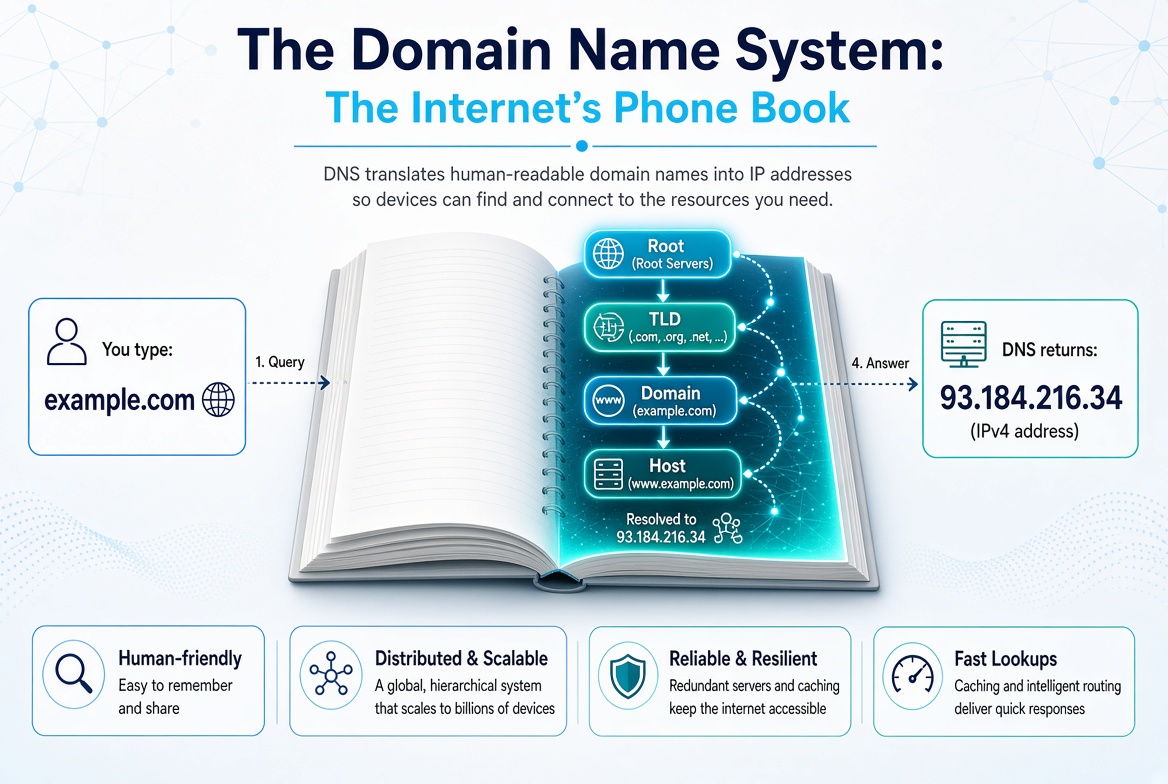
DNS works through a coordinated system of servers arranged in a tree-like hierarchy. At the top sit the root name servers, which know where to find the authoritative servers for top-level domains such as .com, .org, or country-code domains like .uk. When a user types a domain name into a browser, the request typically travels first to a recursive resolver (often run by an internet service provider or a public service such as Google’s 8.8.8.8 or Cloudflare’s 1.1.1.1). That resolver queries the root servers, then the appropriate top-level domain servers, and finally the authoritative name servers for the specific domain. Those authoritative servers return the matching IP address, which the resolver caches for a period defined by a time-to-live (TTL) value. Subsequent requests for the same name can often be answered from cache, improving speed and reducing load on the higher-level servers.
The system also supports more than simple web lookups. DNS records can point to mail servers (MX records), provide security information (DNSSEC), or enable service discovery. Because the hierarchy is distributed, no single organization controls the entire namespace, yet the system remains coherent and highly available.
DNS is indispensable to the operation of the internet. Every time a person visits a website, streams a video, sends an email, or uses a mobile app that connects to a remote server, a DNS lookup almost always occurs first. If DNS were to fail globally, the internet would effectively grind to a halt for ordinary users: browsers would display error messages, email would stop flowing, and cloud services would become unreachable even though the underlying IP networks continued to function. Its design also enables critical features such as content delivery networks, load balancing, and the ability to change a site’s hosting provider without forcing every user to update bookmarks or configurations.
In short, DNS quietly turns the internet’s numerical infrastructure into a human-scale system of memorable names. Invented to solve a practical scaling problem in the early days of networking, it has grown into an essential, largely invisible layer that underpins virtually every online interaction. Without it, the web as we know it would not exist.