How Much Bandwidth Do You Really Need?
Many households today subscribe to (or have access to) 1 Gbps internet plans. Providers market these “gigabit” speeds as the gold standard for modern life—fast enough for seamless 4K streaming, remote work, gaming, and dozens of connected devices. The pitch is compelling. The reality is more nuanced.
In most homes, the high-speed broadband connection does not go straight to your devices. It terminates at a modem or gateway that immediately hands the traffic off to a Wi-Fi router. That wireless hop is where a large share of the promised speed disappears for everyday use.
The Wi-Fi Ceiling Most People Actually Hit
Older or basic routers (still common in many homes) using 802.11n technology top out around a theoretical 300 Mbps on the 2.4 GHz or 5 GHz band. Even newer Wi-Fi 5 (802.11ac) and Wi-Fi 6 equipment, while capable of higher peak rates under ideal conditions, frequently deliver real-world speeds well below the gigabit mark once walls, distance, interference, and multiple devices enter the picture. Studies of home networks consistently show that when the wired ISP link exceeds a few hundred megabits per second, the home Wi-Fi network itself becomes the bottleneck for the majority of users.
You can pay for 1 GigaBit arriving at the wall, yet your laptop, phone, or smart TV on Wi-Fi may only see a few hundred Mbps—or less—on a typical day. Directly-connected devices using ethernet cables bypass this limitation, but most people now prefer the convenience of a wireless connection.
What Everyday Use Actually Requires
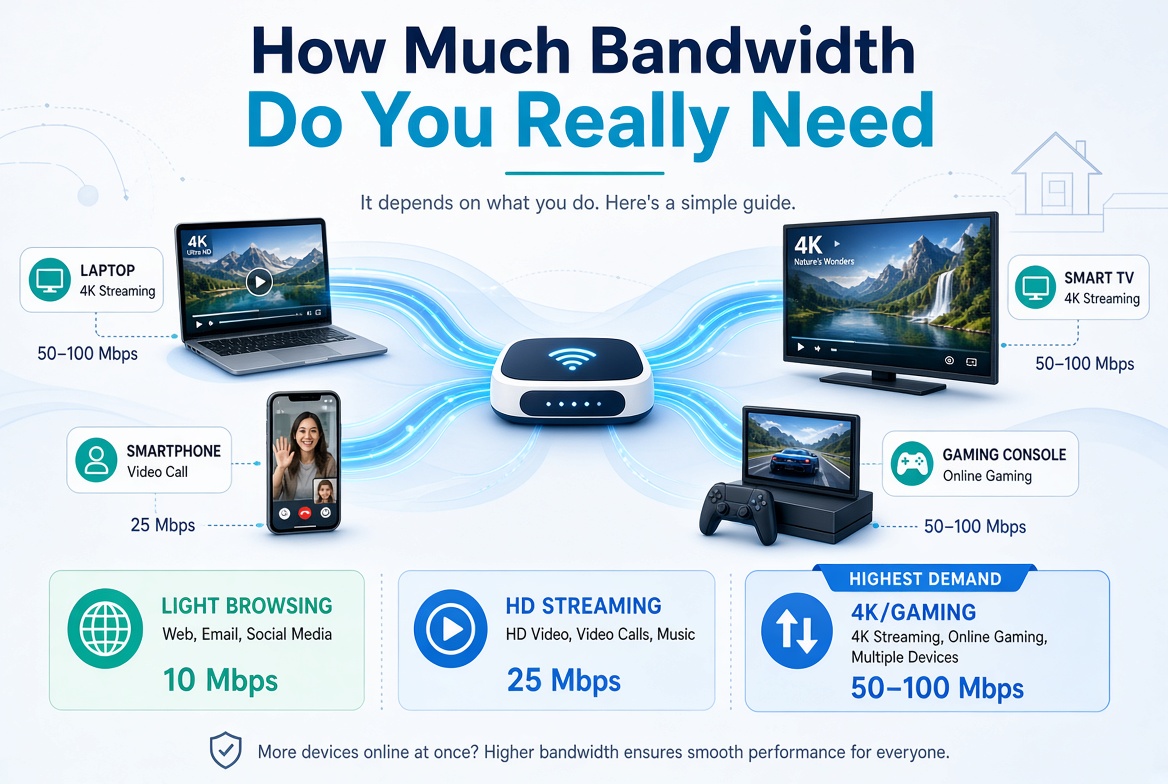
For the activities that dominate most households, i.e. web browsing, email, social media, video calls, and streaming, far less bandwidth is needed than marketing suggests.- Standard definition streaming: roughly 1–3 Mbps
- HD (1080p) streaming: about 5 Mbps per stream
- 4K Ultra HD streaming: 15–25 Mbps per stream (Netflix, Disney+, YouTube, and similar services)
A household running two simultaneous 4K streams plus browsing, messaging, and a video call can stay comfortable on roughly 50–75 Mbps of sustained capacity. Even with several devices active at once, a shared 100 Mbps connection provides enough headroom for uninterrupted performance in the vast majority of ordinary use cases. Background updates, smart-home devices, and the occasional large download fit within that envelope as well.
Only specialized workloads—frequent multi-gigabyte file transfers, professional content creation, competitive multiplayer gaming with strict latency needs, or households with many concurrent 4K streams plus heavy uploads—begin to justify significantly higher sustained speeds.
The Cost of Overpaying
Because the Wi-Fi hop often caps usable speed well below a full gigabit, many households end up paying a premium for capacity they rarely or never fully use. The extra monthly cost for “gigabit” versus a solid 100–300 Mbps plan can add up to hundreds of dollars per year with little practical benefit for typical streaming and browsing. Research into home networks repeatedly finds that once access speeds climb past a few hundred Mbps, the wireless network—not the ISP link—limits real throughput for most users.
Practical Takeaways
Before upgrading to the fastest available plan, test what you actually experience on your devices over Wi-Fi at different times of day. Check whether your router is several years old; a modern Wi-Fi 6 or mesh system can often unlock more of the speed you already pay for than jumping to a higher ISP tier. Prefer Ethernet connections for stationary high-demand devices (desktop PCs, gaming consoles, primary TVs) when possible. Remember, the more devices you have directly connected via an ethhernet cable, the more bandwidth is freed up for WiFi. And match your plan to real household needs rather than the biggest number on the brochure.
For most homes focused on streaming, browsing, and everyday multi-device use, a reliable 100 Mbps connection—delivered cleanly over Wi-Fi—is more than enough. Gigabit speeds sound impressive, but if the wireless path cannot deliver them, the money spent on the extra zeros is largely wasted.