Packets Across the Planet: How TCP/IP Quietly Conquered the World — and Still Rules It
Every time you stream a video, send a message, or load a webpage, tiny digital packages race across the globe, weaving through routers, under oceans, and through the air. They arrive in order, intact, and almost always on time. The invisible set of rules making that possible is TCP/IP—the quiet workhorse that turned a handful of research computers into the nervous system of modern civilization.
The Simple Genius Behind the Name
TCP/IP stands for Transmission Control Protocol / Internet Protocol. Think of it as the ultimate postal system for data.
IP is the addressing and routing part. It gives every device a unique "street address"" and figures out how to get a package from your phone in Honolulu to a server in Frankfurt, even if the path involves a dozen different networks. It doesn’t promise perfection—packages can get lost, delayed, or arrive out of order. It’s pure best-effort delivery.
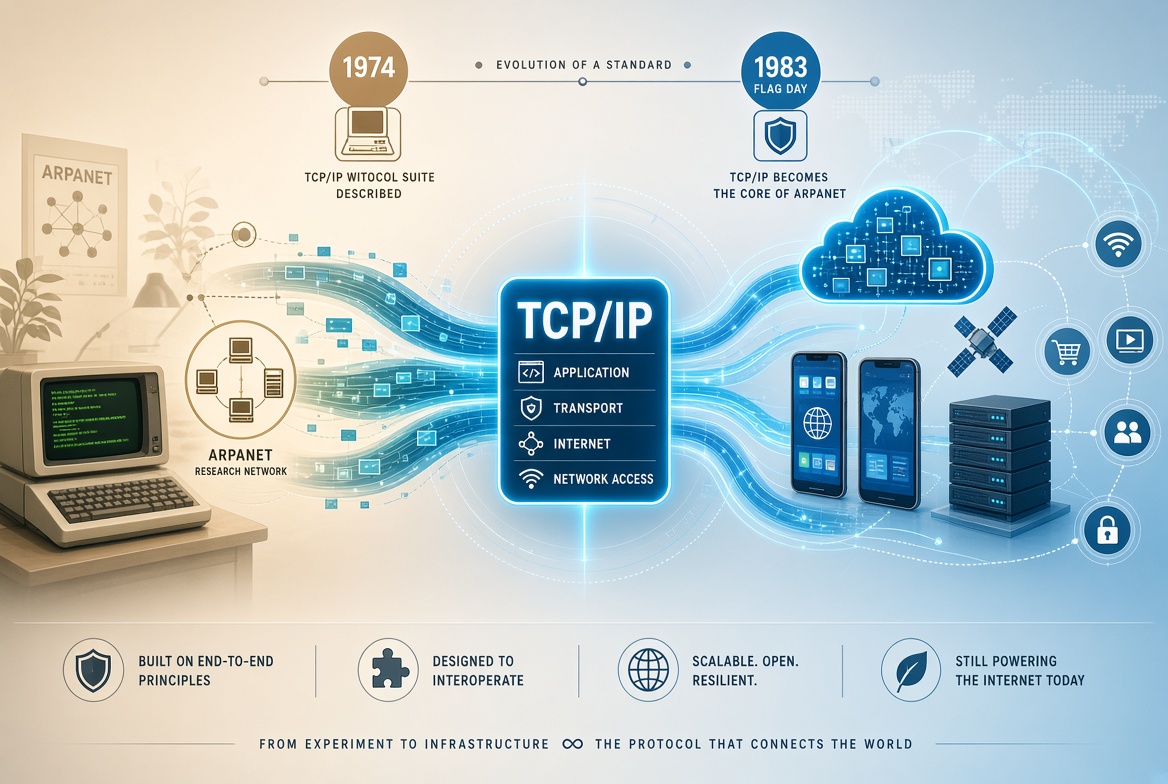
TCP is the careful courier on top of IP. It numbers every package, checks that nothing is missing or damaged, requests replacements when needed, and hands you the complete message in the right sequence. Without TCP, the internet would feel like a chaotic free-for-all. With it, the chaos becomes reliable.
Together they form a layered system: IP moves the packets; TCP (and its lighter sibling UDP) decides how carefully those packets should be handled. This modular design is why the internet can carry everything from banking transactions to live video games without falling apart.
Two Engineers, One Big Idea
In the early 1970s the U.S. Defense Advanced Research Projects Agency (DARPA) had a problem. Its experimental network, ARPANET, worked well—but only for computers sitting in air-conditioned rooms connected by dedicated phone lines. The military needed something bigger: a way to link ground networks, mobile radios, and satellites into one seamless system.
Bob Kahn, a DARPA program manager with a sharp eye for systems, realized the old Network Control Program (NCP) wasn’t up to the job. In the spring of 1973 he reached out to Vint Cerf, a young Stanford professor who had helped build ARPANET’s original host protocols. The two spent months sketching, arguing, and refining. Their solution treated every network as a black box and shifted the burden of reliability onto the computers at each end rather than the network itself.
In May 1974 they published a now-legendary 13-page paper, “A Protocol for Packet Network Intercommunication.” It was the birth announcement of what would become TCP/IP. Later refinements (including a clean split of the original protocol into separate TCP and IP layers) involved other key figures, but Cerf and Kahn remain the principal architects. Their work earned them the Presidential Medal of Freedom, the National Medal of Technology, and a permanent place in computing history.
Flag Day and the Birth of the Modern Internet
For nearly a decade the new protocols were tested, improved, and slowly adopted. Then came the dramatic moment: January 1, 1983—known forever in networking circles as “Flag Day.”On that single day, ARPANET switched completely from the old NCP to TCP/IP. Every machine had to be ready. There was no gradual phase-out; the old protocol was simply turned off. It was risky, stressful, and irreversible. When the switch succeeded, the modern Internet was born.
From there the protocol spread like wildfire through universities, the NSFNET backbone, and eventually the commercial world. Proprietary systems from industry giants—IBM’s SNA, various telecom offerings—couldn’t match its openness and flexibility. TCP/IP won not by corporate muscle but by being useful, free to implement, and designed to connect anything to anything.
Why a 50-Year-Old Protocol Still Runs the Show
Technology moves at breakneck speed. Floppy disks gave way to solid-state drives; dial-up became gigabit fiber. Yet the fundamental rules governing almost every connected device remain the same ones Cerf and Kahn sketched in the 1970s. How?
First, the architecture was deliberately humble and extensible. IP just moves packets. Anyone who doesn’t like how TCP behaves can invent a new transport protocol that still rides on IP. That openness has allowed continuous innovation without tearing up the foundation.
Second, the system proved remarkably adaptable. When traffic threatened to choke the early public Internet, researchers added congestion-control algorithms that still keep the network stable today. When IPv4 addresses started running low, clever workarounds like Network Address Translation bought decades of extra life while IPv6 slowly rolled out alongside it. The core never needed replacing.
Third, it became universal. Every major operating system, every router, every smartphone ships with a TCP/IP stack. Once something reaches that level of ubiquity, replacing it becomes almost unthinkable.
The result is a protocol suite that has survived congestion crises, address exhaustion, and countless predictions of its demise. It defeated better-funded rivals, absorbed new technologies, and scaled from a few dozen research machines to billions of devices without ever losing its essential character.
TCP/IP is not glamorous. It doesn’t have flashy logos or marketing campaigns. It simply works—quietly, reliably, and everywhere. In a world that constantly reinvents itself, that kind of quiet permanence is its own kind of miracle. The next time a webpage loads or a video starts playing without a hitch, you’re witnessing the living legacy of two engineers who decided, half a century ago, that computers should be able to talk to each other no matter where they were or what kind of network they sat on.
And the conversation has never stopped.