The Great Bandwidth Blindside
How Internet Providers Quietly Make Billions by Overselling Bandwidth
Internet providers have pulled off one of the most successful and completely legal marketing strategies of the digital age: convincing millions of households that they need 300 Mbps, 500 Mbps, or even a full 1 Gbps connection—speeds the average family will almost never fully use.
The beauty of the arrangement for the providers is simple. They can deliver a genuine “gigabit fiber to the home” pipe. That physical capacity exists. But the average household’s actual simultaneous demand is a tiny fraction of that capacity. Customers happily pay premium prices for a service that sits mostly idle, generating reliable revenue from bandwidth that is never fully utilized.
Marketing Magic + Measurement Confusion
Creative advertising does most of the heavy lifting. Speed is sold the way horsepower is sold on cars: more is always better, and the biggest number wins. Add to that a widespread public inability to tell the difference between Kbps, Mbps, and Gbps, and you have the perfect conditions for overselling.
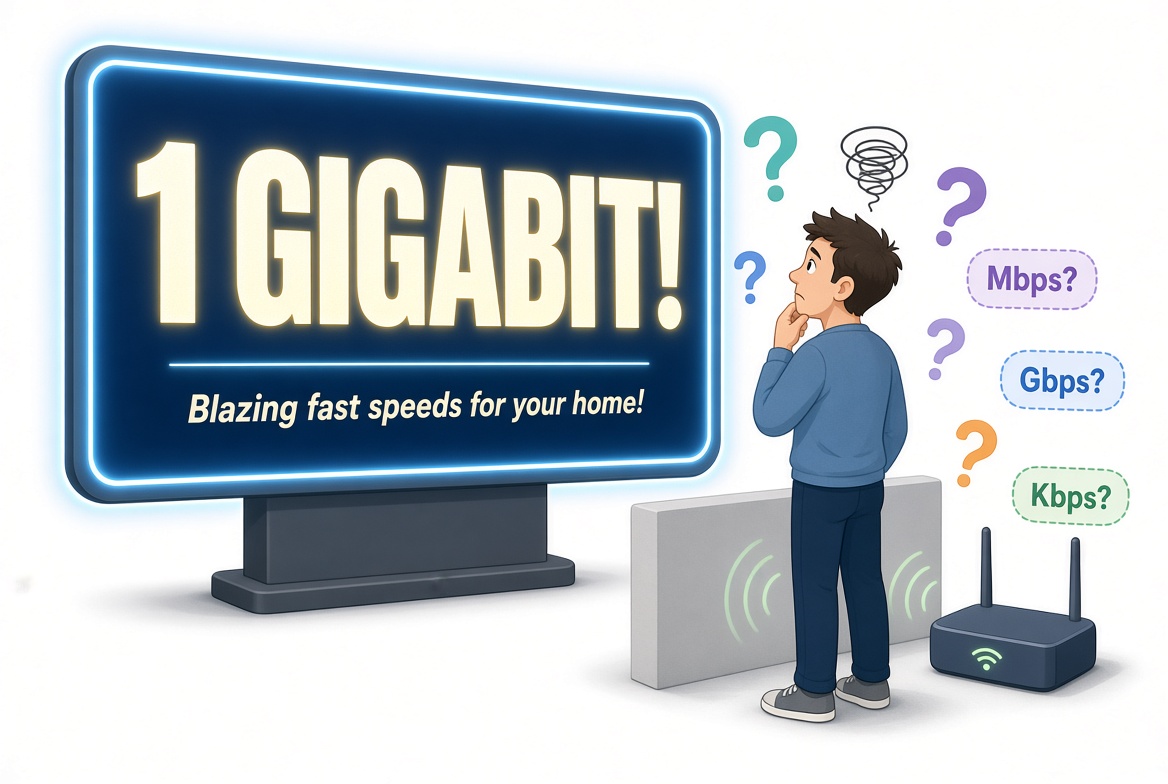
Most people simply do not know what they’re buying. A plan labeled “1 Gig” sounds dramatically faster than “300 Mbps,” even if both are already far beyond what four people streaming, gaming, and video-calling at the same time actually require.
Your Real Bottleneck Is Rarely the Pipe to the House
When the internet feels slow, the first assumption is usually “I need more bandwidth.” In reality, the weak link is far more often inside the home:
- Aging or underpowered Wi-Fi routers
- Crowded 2.4 GHz bands
- Thick walls, floors, and metal appliances that kill signal strength
- Too many devices fighting for airtime on a single access point
A 1 Gbps fiber connection is useless if the Wi-Fi signal that reaches the living-room TV is only delivering 40 Mbps. Upgrading the router or adding a mesh system often solves more real-world problems than jumping to the next speed tier.
How Much Bandwidth Do You Actually Need?
Here are realistic sustained download requirements for common activities (per stream or session):
| Activity | Typical Requirement |
|---|---|
| Email, messaging, light web browsing | 1–5 Mbps |
| General web browsing & social media | 3–8 Mbps |
| SD video streaming (480p) | 3–5 Mbps |
| HD video streaming (1080p) | 5–10 Mbps |
| 4K / Ultra HD streaming | 15–25 Mbps (up to 50 Mbps recommended for headroom) |
| Video calls (HD) | 3–6 Mbps (both directions) |
| Online gaming (gameplay data) | 3–10 Mbps (latency matters far more than raw speed) |
A household of four people each streaming 1080p video at the same time needs roughly 40 Mbps of sustained bandwidth—plus a little headroom. Even four simultaneous 4K streams rarely exceed 100–120 Mbps. Everything above that is, for most families, pure surplus.
Two Simple Analogies
The 40-Lane Highway
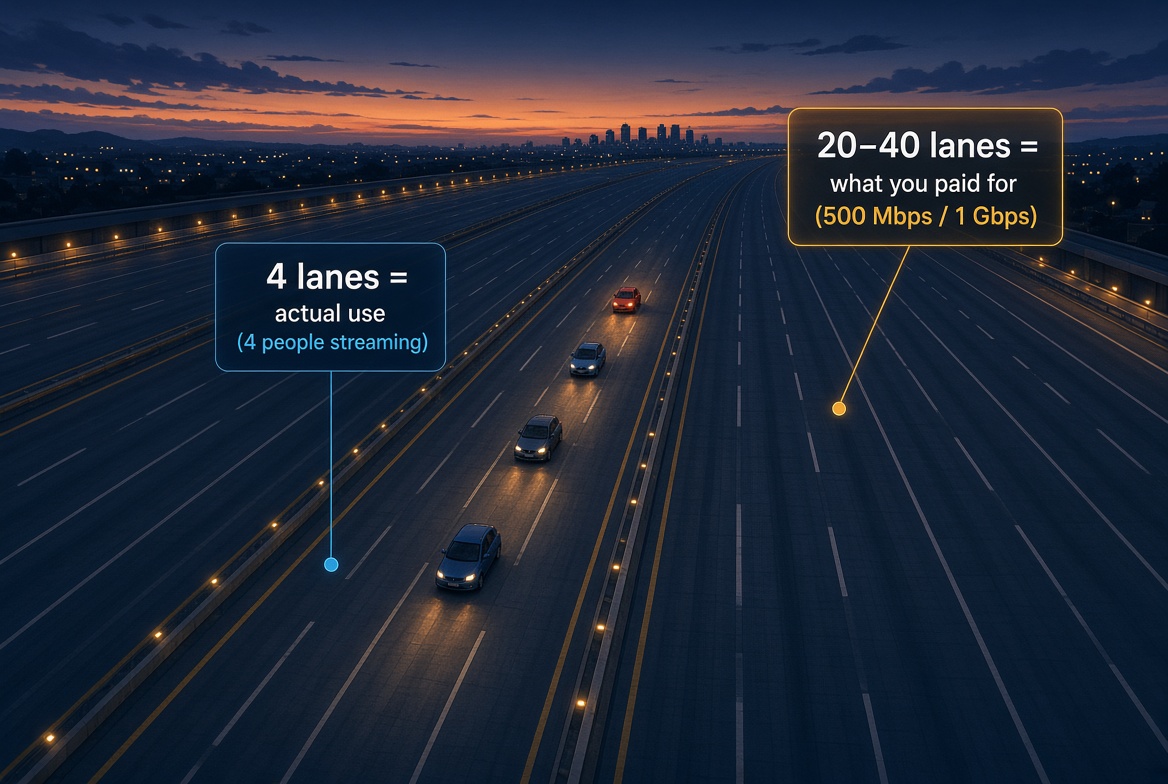
Picture a road where each lane can carry 25 Mbps of traffic. A family of four people streaming video simultaneously needs four lanes. If that same family buys a 500 Mbps plan, they have purchased a 20-lane superhighway. A 1 Gbps plan gives them a 40-lane freeway. Sixteen or thirty-six of those lanes remain completely empty—yet the household pays for every single one of them, month after month.
The 100-Slice Toaster
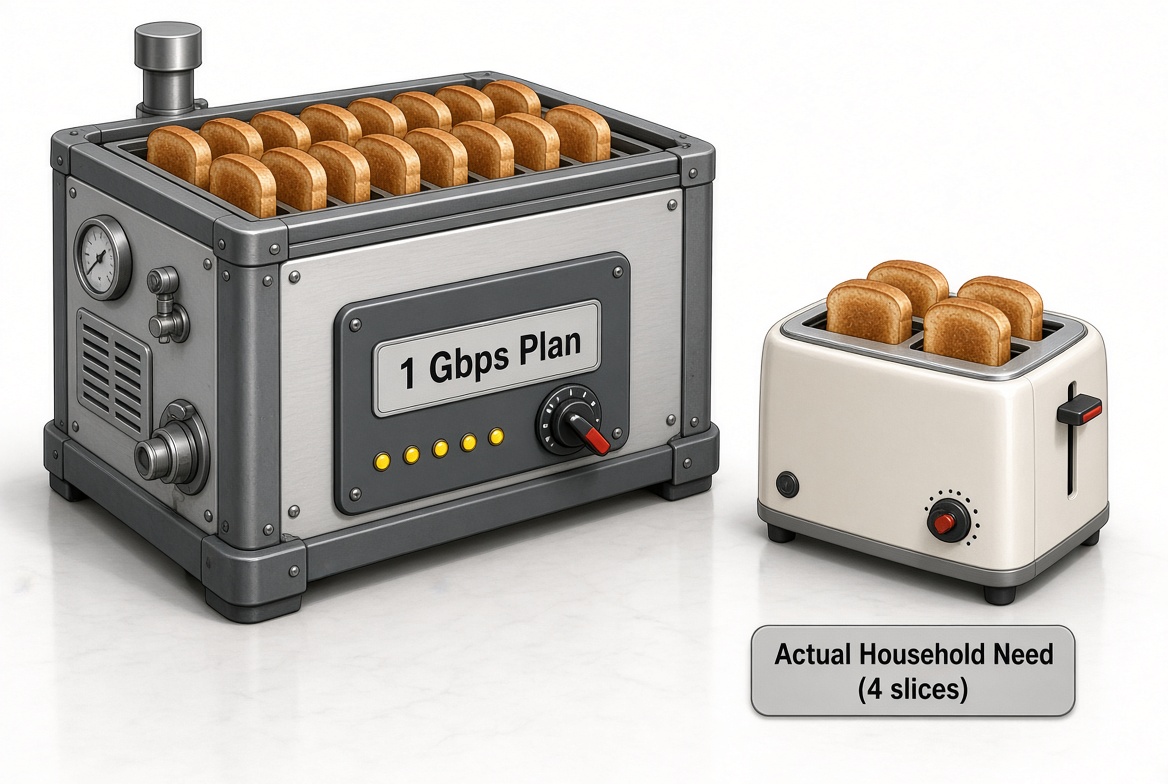
Imagine walking into a store and being sold a toaster that can brown 100 slices of bread at the exact same moment. The salesperson insists you need it because “tomorrow you might have a huge party.” In reality, the average household wants four slices at breakfast. You still pay the full price of the industrial machine every month, even though 96 of the slots stay cold forever.
The Bottom Line
Purchasing massive bandwidth plans is often unnecessary. For the great majority of households, a well-engineered 100–300 Mbps connection is more than enough—especially when paired with modern Wi-Fi equipment and sensible placement. The extra hundreds of megabits (or full gigabit) mostly exist to make the monthly bill larger, not to make your Netflix, Zoom, or gaming experience meaningfully better.
Before you upgrade, run a real speed test during peak evening hours, check your Wi-Fi signal strength in the rooms you actually use, and do the simple math of concurrent streams. You may discover you’ve been paying for a lot of empty lanes—and a toaster that never makes more than four slices.